Our Services
LA ADU Financing: Practitioner Playbook for Lender-Ready Budgets
A practical, Los Angeles–focused ADU financing playbook: compare HELOCs, construction-to-perm loans, verify CalHFA's up-to-$40,000 grant, and build...
- CSLB C-20 Licensed
- NATE Certified
- EPA 608 Certified
- Licensed & Insured
For most Los Angeles homeowners, the fastest realistic path to an ADU is a HELOC or home equity loan against existing equity, paired with a fixed-price contractor bid before you touch a lender. Construction-to-permanent loans work well if you need one clean closing. Cash-out refinancing only makes sense if your current mortgage rate is already high. The CalHFA ADU Grant Program can hand you up to $40,000 for predevelopment costs, but funding rounds come and go, so verify availability before you build a budget around it.
TL;DR:
- Most LA homeowners should consider a HELOC or home equity loan, drawing funds in stages as construction progresses and paying interest only on what is used.
- Grant programs, like CalHFA’s up to $40,000, can help cover predevelopment costs but are limited in availability and do not fund construction directly.
- The total ADU cost ranges from soft costs and site delays to full build expenses, with detached units at the highest end, often requiring contingency budgets.
- Homeowners should secure fixed-price contractor bids and multiple lender quotes before applying for financing, ensuring documentation aligns with lender requirements.
- Combining financing with proper planning, permit-ready documentation, and collaboration with experienced local contractors minimizes delays and ensures project approval.
Adu Financing Los Angeles: Breaking Down Your Real Options
Every ADU financing conversation in Los Angeles starts with the same question: what do you already have, and what do you still need to borrow? The answer usually points to one of eight product types, and each one fits a different homeowner situation.
A HELOC (home equity line of credit) is the most common tool for a reason. You draw money as construction phases finish, pay interest only on what you’ve drawn, and typically qualify up to 80 to 90% combined loan-to-value depending on the lender. That flexibility matches how ADU construction actually happens, in stages, with costs that shift as the project moves forward. It also explains why A majority of California ADU borrowers use a HELOC or home equity loan rather than any other product.
A home equity loan trades that flexibility for a fixed rate and a lump sum, which suits homeowners who already have a locked-in contractor bid and know the total cost. A cash-out refinance replaces your existing mortgage entirely, and it only pencils out if your current rate is already above market.
Construction-to-permanent loans roll the build financing and the long-term mortgage into a single closing, with an interest-only draw period during construction that converts automatically once the ADU passes final inspection. FHA 203(k) and Fannie Mae HomeStyle or CHOICERenovation loans work similarly but open the door wider on credit requirements, and recent underwriting updates now let some lenders count projected ADU rental income toward qualification, which matters if your income alone wouldn’t otherwise support the loan.
For homeowners with limited equity, after-repair-value (ARV) renovation lenders underwrite against the home’s value after the ADU is built rather than its current value. Once construction wraps, some owners refinance into a DSCR loan, which qualifies based on the rental income the ADU generates instead of personal income. And plenty of people simply pay cash for smaller conversions, particularly garage-to-ADU projects.
- HELOC: interest-only draws, staged funding, best for known equity
- Home equity loan: fixed rate, lump sum, best for fixed-price bids
- Cash-out refinance: only smart if replacing a higher-rate mortgage
- Construction-to-perm: one closing, converts after inspection
- FHA 203(k) / HomeStyle / CHOICERenovation: counts projected rent
- ARV lenders and post-completion DSCR refinancing: for limited equity
Pro Tip: Credit unions and specialty ADU lenders often beat big-bank pricing on HELOCs and construction loans, so get at least one quote from each before committing.
What California and Los Angeles ADU Grant Programs Exist?
Grant money for ADUs in California does exist, but it’s not a foundation to build a budget on. Here’s what’s actually available and how to use it.
- CalHFA ADU Grant Program. This offers up to $40,000 to reimburse predevelopment costs](https://www.calhfa.ca.gov/adu/), things like architectural plans, permit fees, and soils reports, for eligible homeowners, typically owner-occupants under certain income and property limits. Funding rounds have run out fast before, so always check the current status directly on calhfa.ca.gov/adu rather than trusting a secondhand claim.
- County and city programs. Los Angeles County has offered forgivable loans, fee waivers, and technical assistance through nonprofit partners, including programs run through NHS LA County that pair HUD-certified housing counselors with eligible applicants.
- CDFIs and housing counselors. Community development financial institutions often offer below-market ADU loans to homeowners who qualify by income, and a HUD-certified counselor can walk you through eligibility for free.
Grants almost never cover construction itself. Pair one with a HELOC or construction loan, don’t count on it replacing your primary financing.
What Do LA ADUs Actually Cost, and How Long Do They Take?
ADU cost in Los Angeles varies enormously depending on scope, and the number that surprises most homeowners is how much soft costs eat into the budget before a single wall goes up.
A garage conversion or junior ADU tends to run cheapest since it reuses existing structure. A small attached ADU costs more per square foot because of new foundation and utility work. A detached one or two bedroom unit sits at the top of the range, driven by full utility hookups, a separate roof and foundation, and site work. You can see a fuller local breakdown on Upright Construction & HVAC’s ADU cost guide.
- Soft costs: architectural plans, structural and soils reports, sewer and utility hookups, permit and impact fees, Title 24 energy compliance
- Contingency: budget 10 to 15% above your contractor bid, since lenders won’t fund cost overruns once construction starts
- Permitting: LADBS review timelines and site constraints flagged through ZIMAS parcel data can add weeks or months, which delays when your lender releases draws
Check your parcel on ZIMAS before you finalize design. Easements, zoning overlays, or setback issues discovered late in the process can force redesigns that blow past your original financing timeline.
How Should You Choose a Financing Path?
Three steps get most homeowners to a decision faster than endless comparison shopping.
- Assess your equity and current mortgage rate first. If you have 20% or more equity and a mortgage rate below today’s market, a HELOC or home equity loan almost always beats refinancing.
- Get two or three fixed-price bids from licensed local contractors before you talk to a single lender. A real number changes what loan product makes sense far more than any lender’s estimate.
- Collect quotes from at least two lenders, including a credit union and a specialty ADU lender, and compare total cost and draw timing, not just the advertised rate.
When you talk to lenders, ask directly: will you count projected ADU rental income in underwriting? What’s your appraisal policy and combined loan-to-value cap? What does the draw schedule look like during construction, and what happens if the project runs long? Is there a clean path to convert this into permanent financing after completion?
When you talk to contractors, ask for fixed-price contracts rather than cost-plus billing, proof of LADBS permit experience, a written change-order policy, and lien waiver practices that satisfy your lender’s draw requirements. Construction lenders generally require these documents before releasing funds, and missing paperwork is the most common reason draws get delayed.
Watch for red flags: any lender who guarantees you’ll get a state grant, any appraisal projection that sounds too optimistic against your build cost, any contractor who’s never pulled an LADBS permit, or any project bid with zero contingency built in. The appraisal gap is real.
What I’ve Learned Helping LA Homeowners Finance Their ADUs
Experience shows that ADU projects go smoothly when financing and construction planning happen together, not in sequence. Homeowners who lock in a lender before they have a real bid usually end up either underfunded or stuck redesigning mid-project.
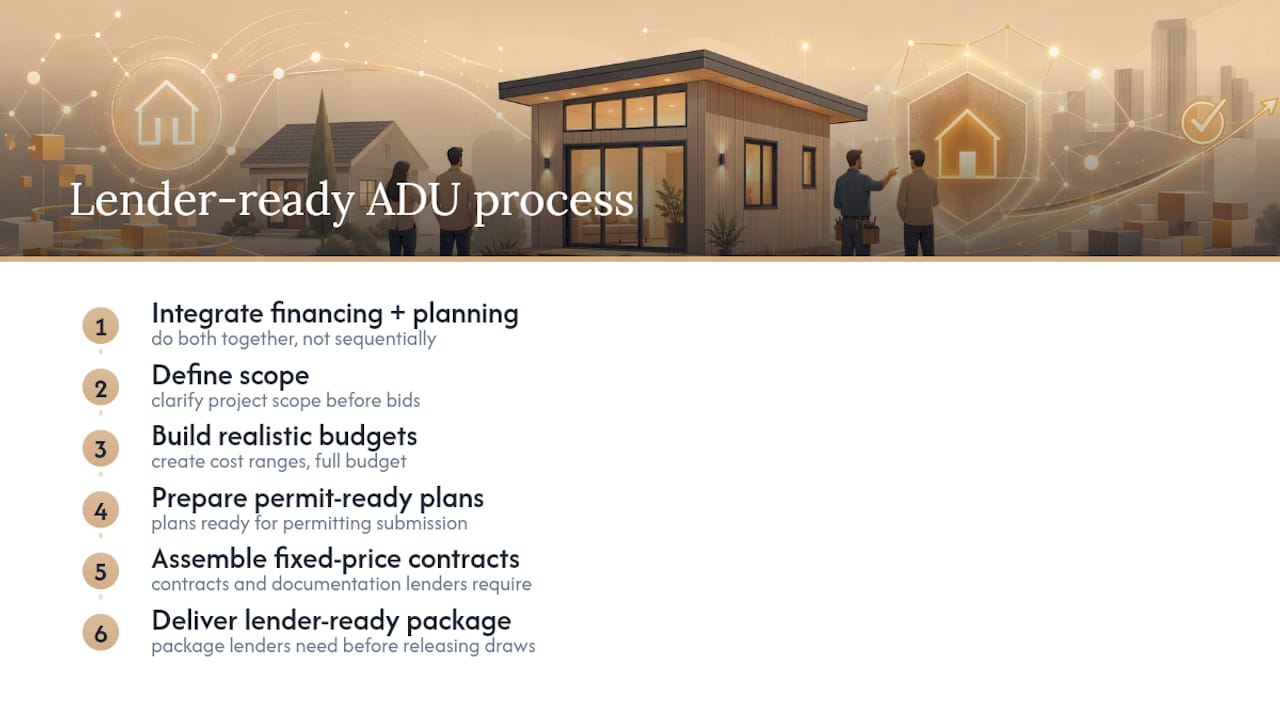
We build budgets, prepare permit-ready plans, and put together the fixed-price contracts and documentation that lenders want to see before they release a draw. That’s the piece people underestimate: a lender doesn’t just want a number, they want proof the number holds up. Our ADU consultation process walks you through scope, realistic cost ranges, and what your financing package needs to look like before you ever sign with a lender.
If you’re ready to talk through your specific lot, budget, or timeline, reach out and we’ll walk you through it directly.
— Ernie M
Get an ADU Consultation That Fixes What Financing Guides Can’t
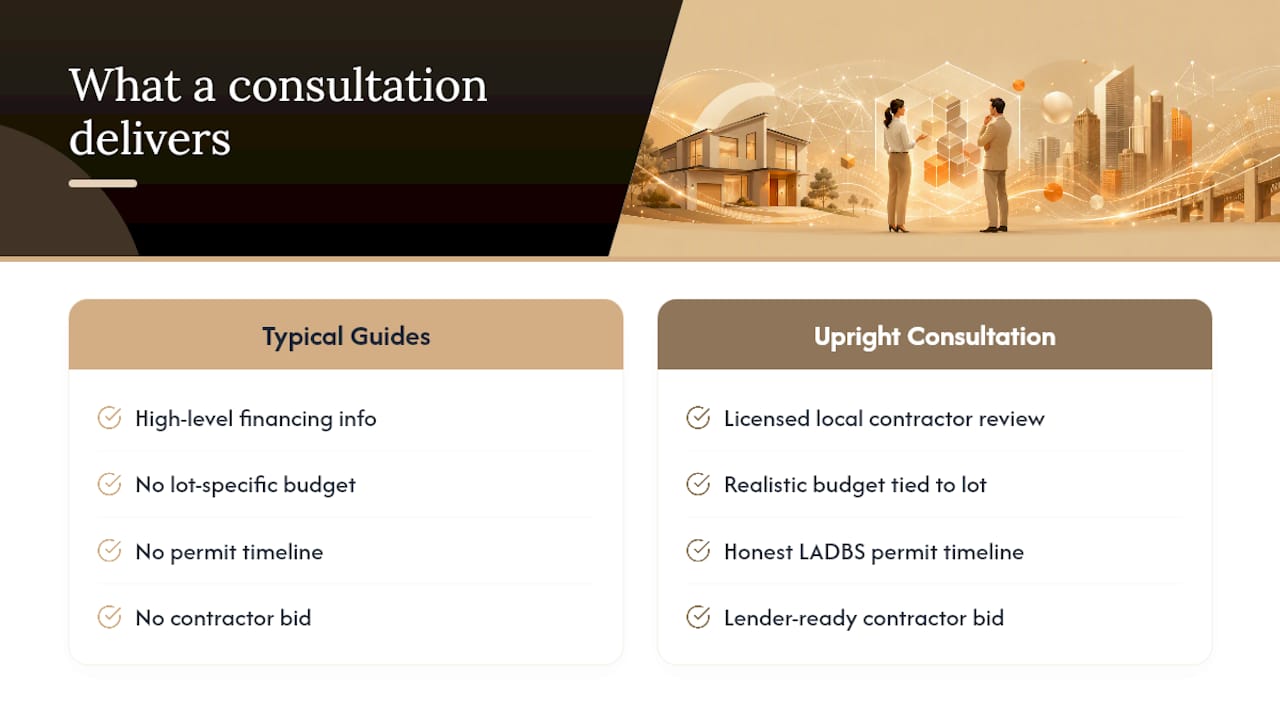
Reading about HELOCs and construction loans only gets you so far. What actually moves a project forward is a licensed local contractor who knows Los Angeles permitting cold and can hand your lender a real bid instead of a guess.

That’s where Upright Construction & HVAC earns its keep. We’ve handled ADU construction, permit processing, and budgeting and ROI analysis across Los Angeles for over 15 years, and we know exactly what documentation turns a maybe into an approved draw schedule. A consultation with us covers scope review, a realistic budget estimate tied to your lot, an honest LADBS permit timeline, and guidance on which financing route fits your situation, including referrals when a specific loan product is outside our scope.
We also handle the HVAC integration piece most ADU guides skip entirely, since a unit without proper heating and cooling isn’t rentable or livable. If you’re comparing HELOCs, construction loans, or grant options, start with a real consultation. Schedule your ADU consultation with Upright Construction & HVAC and get a plan built around your actual lot, not a generic estimate.
Where to Verify Program Status and Permit Rules
Before you commit to a financing path, confirm the details directly with the sources that set the rules.
- CalHFA ADU Grant Program: current funding status and eligibility for the up to $40,000 predevelopment grant
- LADBS ADU guidance: permit requirements and process steps specific to Los Angeles
- ZIMAS parcel lookup: zoning overlays and site constraints that affect design and cost
- NHS LA County ADU Grant Program: county-level alternatives and HUD-certified counseling
- For a broader comparison of home equity products against project-specific loans, see this HELOC versus project loan breakdown
This article is general information, not a substitute for advice from a qualified financial advisor. Consult a qualified financial professional about your own circumstances before acting on anything here.
Sources
- ADU Grant Program - CalHFA
- Accessory dwelling units (ADUs) | LADBS
- How to Finance an ADU in California: HELOC vs Construction Loan vs Cash-Out Refi (2026) | ADU Pilot
- ADU Grant Program (NHS LA County)
FAQ
Is There a $40,000 ADU Grant Available in California?
Yes, through the CalHFA ADU Grant Program, which reimburses up to $40,000 in predevelopment costs for eligible homeowners, but funding rounds are intermittent, so confirm current availability before counting on it.
Is There Financing Specifically for ADUs in California?
Yes. Homeowners commonly use HELOCs, home equity loans, cash-out refinances, construction-to-permanent loans, and renovation mortgages like FHA 203(k) or HomeStyle, several of which now allow projected ADU rental income in underwriting.
Is There a California ADU Grant Program in 2026?
The CalHFA ADU Grant Program continues to operate into 2026, but rounds have been exhausted quickly in the past, so check calhfa.ca.gov/adu directly rather than assuming funds are open.
What Is the Best Way to Finance an ADU?
For most Los Angeles homeowners with equity, a HELOC or home equity loan offers the most flexible and affordable path, especially when paired with a fixed-price contractor bid. Homeowners with less equity often do better with a construction-to-permanent loan or a renovation mortgage that counts projected rental income.
Does Upright Construction & HVAC Help With ADU Financing Documents?
Yes. Upright Construction & HVAC prepares the fixed-price contracts, permit-ready plans, and budget documentation that lenders typically require before releasing construction draws, and can refer homeowners to financing resources during a consultation.
Recommended
Ready to get started?
Licensed, insured & available 24/7 across Los Angeles and the San Fernando Valley.